7 minute guide
Water resonance: how sound frequency affects water
When a container of water is vibrated, energy can organise its surface into ripples, standing waves and geometric modes. The pattern is real physics, but the frequency number is only one part of the setup.
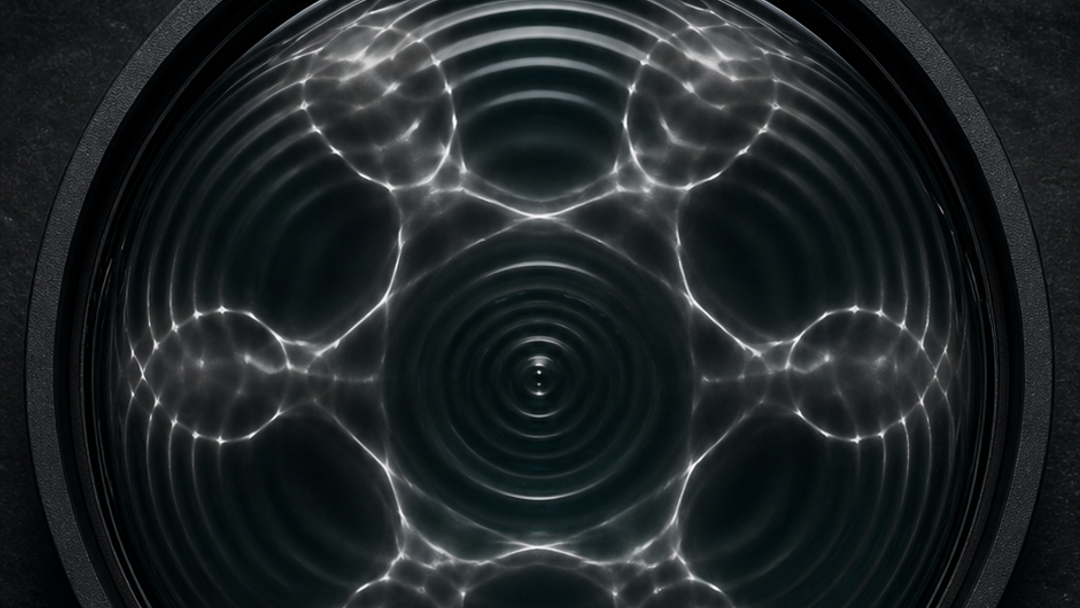
Vibration can organise a water surface
A water surface normally returns towards flatness under gravity and surface tension. When its container is driven repeatedly, the incoming energy can reinforce particular wave modes. Above the relevant threshold, stable or changing standing-wave patterns can become visible.
These are often called Faraday waves when vertical vibration produces a subharmonic surface response. In a controlled experiment, the drive frequency, acceleration and the liquid's properties can all be measured rather than inferred from the appearance alone.
Frequency is one control, not the whole recipe
Changing frequency can change the available wavelength and mode, but the same frequency does not guarantee the same picture in a different setup. Water depth, vessel diameter and shape, drive amplitude, viscosity, surface tension, boundary conditions and even how the vibration enters the vessel can alter the result.
Research on cylindrical containers shows that the observed spatial structure conforms to the container when wavelengths are comparable with its size. This is why a striking cymatics image should include its physical setup before it is treated as a universal signature of one frequency.
- Frequency: how quickly the system is driven.
- Amplitude or acceleration: how strongly energy enters the system.
- Depth and geometry: which wave modes fit inside the boundary.
- Fluid properties: how readily waves form and how quickly they lose energy.
Why the pattern can change suddenly
A smooth frequency sweep does not always produce a smooth visual change. The surface can remain comparatively flat below a threshold, then enter a resonant mode once the forcing is strong enough. A further change can reorganise the surface into another mode or a less ordered state.
That sensitivity is part of the phenomenon. It also means two short online demonstrations may look different even when their captions display the same hertz value.
A speaker demonstration needs mechanical coupling
The clearest water-pattern experiments mechanically connect a vessel or plate to a controlled vibration source. Playing an audible tone near a glass is a different and much less controlled arrangement: the speaker, air, table, vessel and water each affect how much energy reaches the surface.
Small speakers can reproduce audible sound, but they are not automatically strong or stable mechanical drivers for visible water modes. A frequency readout on a phone does not verify the force delivered to the water.
What this says about listening
Water-wave demonstrations establish that physical systems can respond differently to vibration parameters. They do not establish that a particular audible frequency heals tissue, forces sleep or produces the same geometric pattern inside a person.
For relaxation audio, the useful questions remain practical: is the signal accurately generated, is it comfortable on the intended playback system, does it avoid abrupt changes, and does the complete listening experience help the listener settle? Those questions can be tested without turning a compelling visual experiment into a medical promise.
What is the resonant frequency of water?
Water does not have one universal resonant frequency. The visible modes depend on the water depth, container geometry, drive strength, fluid properties and how vibration enters the system.
Can sound frequency create patterns in water?
Controlled mechanical vibration can create ripples and standing-wave patterns on a water surface. Frequency matters, but it works together with amplitude, boundaries and the physical coupling of the setup.
Do water-frequency patterns prove a health effect?
No. A water pattern demonstrates a fluid system responding to vibration. It does not show that the same frequency produces a medical effect or the same pattern inside the body.
Sources and next reading
Follow the useful trail.
Listen tonight